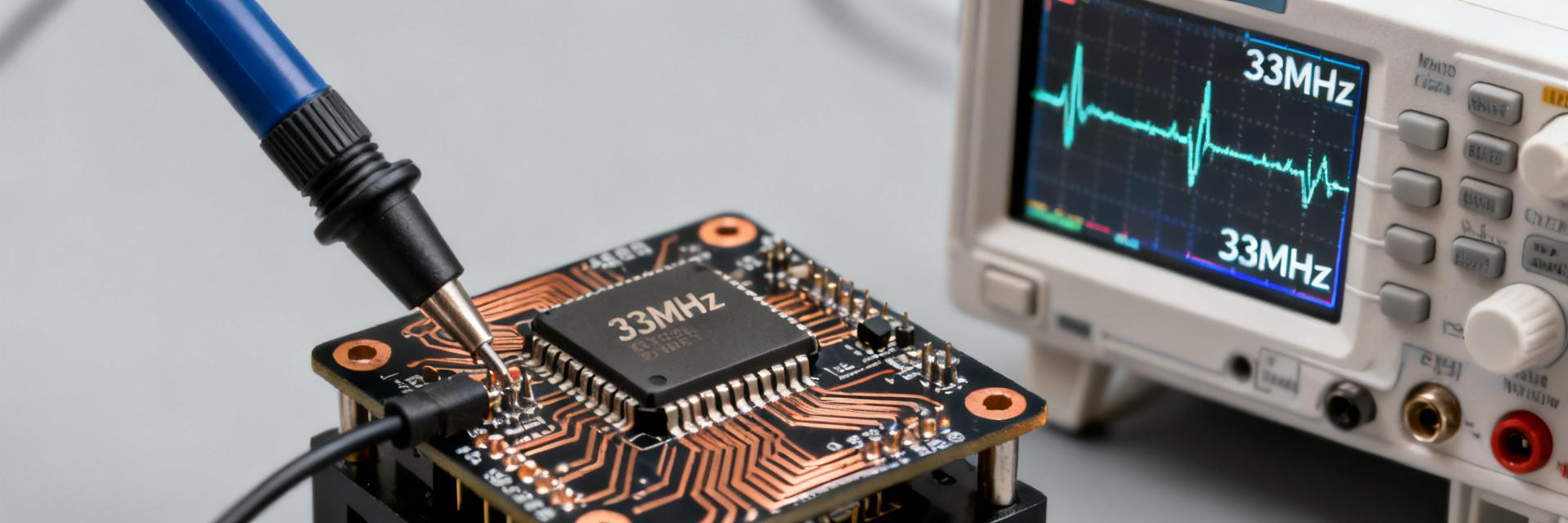
Lab measurements were performed on the DSA1203DA3 100MHz XO to quantify phase noise and frequency stability under controlled conditions, emphasizing implications for timing- and jitter-sensitive systems. This report summarizes the test bench and methods used, outlines phase-noise behavior, reports Allan deviation trends, and gives practical recommendations for system designers.
1 — Why a 100MHz XO matters
Typical system roles & performance targets
A 100MHz XO often serves as a precise reference for ADC/DAC clocking or RF up/down conversion. For ADC clocking, the dominant concern is integrated jitter (ps RMS) across the converter’s sensitivity band. Engineers must map component requirements to system jitter and BER budgets before selection.
| Offset Frequency | Typical Phase Noise (dBc/Hz) | Integration Band |
|---|---|---|
| 10 Hz | -90 | Close-in stability |
| 100 Hz | -120 | Reference PLL tracking |
| 1 kHz | -145 | Loop bandwidth region |
| 10 kHz | -155 | Jitter contribution floor |
| 1 MHz | -165 | Broadband white noise |
2 — Measurement setup & methodology
Test bench & noise-floor control
We utilized a cross-correlation phase-noise analyzer to lower the system floor below the DSA1203DA3's intrinsic noise. Calibration included instrument-specific tones and verification against a known ultra-low-noise reference. The environmental setup involved a localized thermal chamber and low-noise linear regulation (LDO) to minimize external supply modulation.
3 — Measured phase noise: results & analysis
Noise-source decomposition & Leeson fit
By fitting a Leeson-model overlay, we separated white phase noise from flicker (1/f) contributions. Measurements indicate that the buffer amplifier dominates far-out noise (>-160 dBc/Hz), while the resonator's Q-factor governs the slope within the 10Hz-1kHz region. These insights allow for precise jitter prediction in high-speed data converter applications.
4 — Stability & environmental sensitivity
Allan deviation (σy) curves were captured from τ = 1 s to 10,000 s. The results show a clear white-FM region transitioning to a flicker-FM floor at longer integration times. Frequency pull vs supply voltage was measured at ~0.5 ppm/V, suggesting that high-PSRR regulation is essential for maintaining sub-ps jitter in switching environments.
5 — Practical implications & recommendations
- ADC Integration: Maintain reference integrated jitter well below the converter’s aperture jitter spec.
- Layout: Place the XO close to the target IC to minimize trace length-induced ringing.
- Regulation: Use a dedicated ultra-low-noise LDO to isolate the XO from digital rail noise.
Key summary
- The DSA1203DA3 100MHz XO requires phase-noise plots at standard offsets and integrated jitter calculations to predict performance.
- Use cross-correlation to lower instrument floor and capture ADEV from 1 s to 10⁴ s.
- Apply a Leeson fit to separate flicker and white contributions; mitigate noise with thermal control and improved regulation.
Frequently Asked Questions
What phase noise should I expect from a DSA1203DA3 measurement?
Expect the phase-noise measurement to show distinct close-in (flicker) and far-out (white) regions. The exact dBc/Hz numbers depend on part class; always report measured traces alongside instrument floor settings for context.
How do I convert phase noise to RMS jitter for ADC clocking?
Integrate the single-sideband phase-noise curve across the converter-relevant frequency band, convert to rms phase (radians), and divide by 2πf0 to obtain seconds of jitter; multiply by 10¹² for ps.
Which offsets and tau points are essential for qualification?
Report phase noise at 1 Hz, 10 Hz, 100 Hz, 1 kHz, 10 kHz, and 100 kHz. For Allan deviation (ADEV), report τ = 1 s, 10 s, 100 s, 1,000 s, and 10,000 s to identify long-term drift.
How does temperature affect the DSA1203DA3?
The frequency vs temperature curve follows a stability polynomial. It is critical to quantify tempco in ppm/°C to ensure system margins across the full operational range, especially for outdoor or industrial deployments.