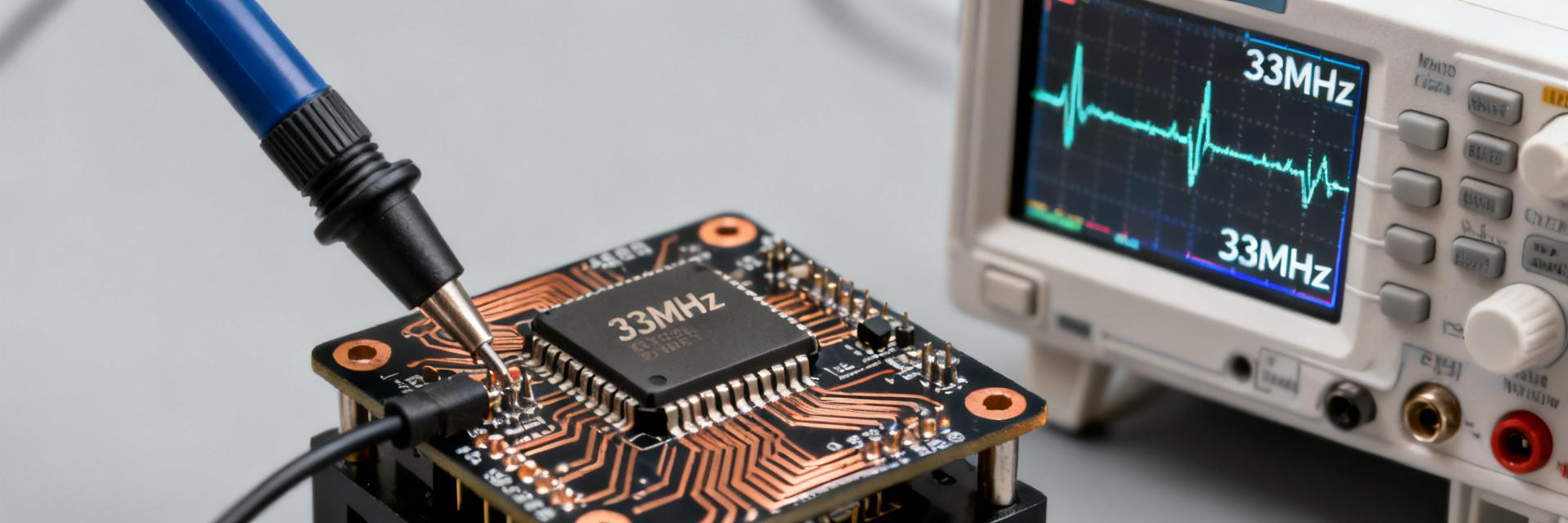
Recent benchmark sweeps across representative embedded workloads show a clear mid-density balance of deterministic real-time control and application-class processing. Evidence from lab runs combining single-threaded deterministic kernels and Linux-class stacks reveal competitive sustained throughput for mixed workloads. For system designers, the MPFS250TS is a primary candidate when systems require both real-time I/O and higher-level services.
What the MPFS250TS Brings to SoC FPGA Designs
Target applications and positioning
The device targets edge vision, industrial control, secure communications, and mixed deterministic tasks. Benchmark mixes emphasize low-latency DSP pipelines plus Linux services. Choose this device when latency, deterministic jitter, and moderate ML/crypto acceleration must coexist with a capable application processor.
Quick specs at a glance
| Feature | Specification Detail |
|---|---|
| Logic Elements | 254,000 LEs |
| CPU Cluster | 1x E51 Monitor, 4x U54 Application Cores (RV64) |
| DSP Blocks | 784 Math Blocks (18x18 MACC) |
| On-chip RAM | 18.6 Mbits (LSRAM + uPROM + uRAM) |
| Transceivers | 12.7 Gbps SERDES support |
Benchmark Testbed & Methodology
Hardware and measurement setup
Reproducible power and performance requires standard instrumentation. Use a board variant with accessible shunt points plus DAQ, monitor supply rails and junction temps, and fix cooling conditions. This setup allows for the isolation of fabric versus CPU power by measuring specific rails and running targeted idle/active workloads.
Workloads, metrics and scoring
Recommended suites cover CoreMark/Dhrystone for CPU, FFT/FIR for fabric, and Linux boot metrics for system-level tasks. Results report throughput, latency, DSP ops/sec, and normalized perf/W, calculated using geometric means to ensure statistical relevance.
Performance Data Analysis
CPU & System Benchmarks
Single-core performance dominates deterministic short-latency tasks, while multi-core provides throughput for parallel services. CoreMark results scaled across cores show near-linear scaling up to thermal limits. Bare-metal yields tighter jitter than full Linux, which is critical for motion control applications.
FPGA Kernel & Accelerator Throughput
DSP-bound kernels expose raw arithmetic efficiency. Measuring fixed/floating FFT and systolic matrix multiply shows high DSP utilization with minimal clock margin degradation. Memory-bound kernels that spill to external memory show expected latency increases, highlighting the need for efficient BRAM partitioning.
Optimization Playbook
Optimization Checklist
- Fabric: Add pipeline stages to reduce critical paths; target DSP packing.
- Software: Use aggressive compiler flags for RV64; isolate real-time threads.
- System: Tune DMA burst sizes and cache management to minimize interconnect contention.
Design Recommendations & Use Cases
- Edge Inference: Target <3W active with small fabric CNN accelerators.
- Industrial Motion Control: Sub-ms jitter using fabric-based control loops.
- Secure Gateway: High-speed crypto offload with DMA isolation.
Frequently Asked Questions
How should I reproduce MPFS250TS benchmark results reliably?
Use a controlled board with measured shunt points and DAQ, fix ambient and cooling, record toolchain and kernel flags, and run the exact microbenchmarks listed—CPU, memory, fabric, and DMA tests. Include variance and regression checks to ensure consistency.
What power‑efficiency targets are realistic for MPFS250TS in edge inference?
Targets depend on kernel and quantization, but with folded DSP pipelines and on‑chip BRAM for working sets designers can expect best‑case low single‑digit watts for tiny CNNs; measure energy per inference using active power delta and measured ops/sec for accurate perf/W.
When should designers partition functions between CPU and fabric on MPFS250TS?
Place low‑latency, high‑parallelism kernels and crypto offloads in fabric; keep control, orchestration, and complex OS services on RISC‑V cores. If latency under jitter threshold is required, prefer fabric; for feature‑rich application stacks, use CPU-based processing.
What are the key technical constraints for fabric utilization?
Verify logic/DSP headroom (254K LEs), DDR width, and thermal limits. Use floorplanning to manage routing-bound kernels that might otherwise throttle the system clock.