
SiC MOSFET 3300V Performance Report: Key Specs & Metrics
SiC MOSFET 3300V devices are producing step changes in high-voltage power conversion metrics. Measured Rds(on) rise from 25°C to 150°C commonly ranges from 1.8× to 3.0×, with switching-energy reductions of 40–60% vs legacy silicon.
This report is vendor-agnostic and metric-focused, providing checklists and benchmark tables to help engineers evaluate megawatt-class converters and HVDC front ends.
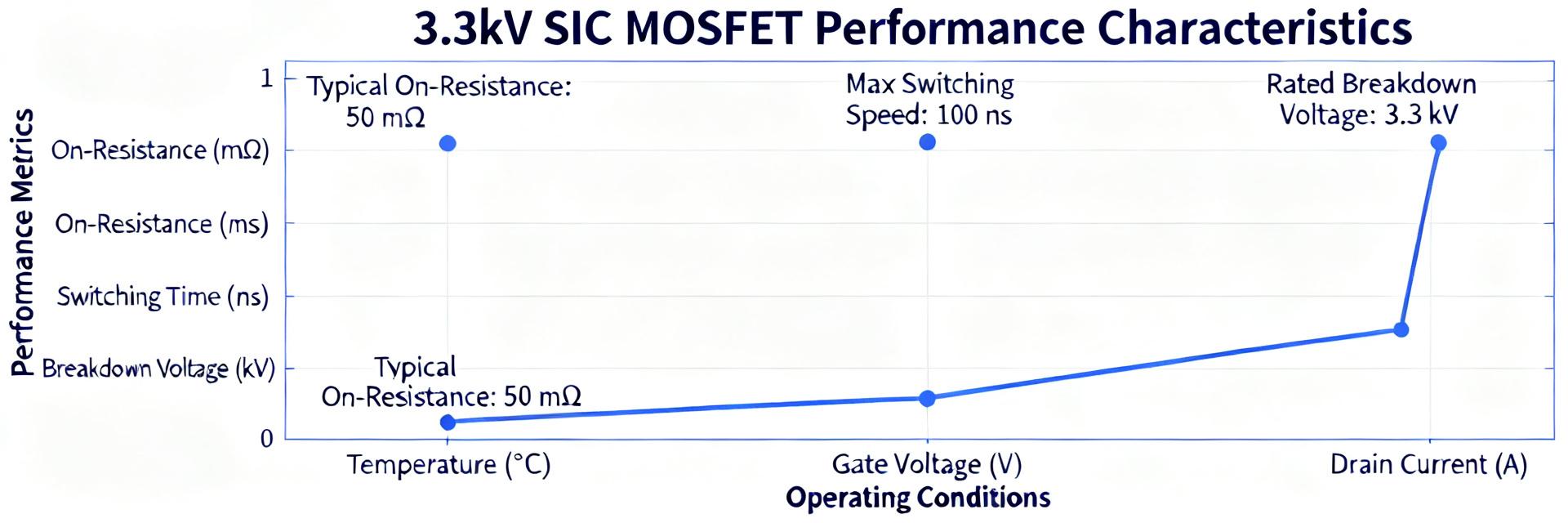
1 — Background: Why 3300V SiC MOSFETs matter for high-voltage systems
1 — Application landscape and technical drivers
Point: 3.3 kV-rated SiC MOSFETs enable consolidation of stacks and simplification of topology.
Evidence: Target applications include utility-scale converters, HVDC submodules, electric traction traction inverters, industrial high-voltage drives, and extreme fast-charging infrastructure where higher blocking voltage reduces series device counts.
Explanation: Fewer series devices lower balancing complexity, reduce DC-link capacitor count, and shrink insulation and spacing demands for system-level cost and reliability gains—key considerations for applications for 3300V SiC MOSFET and 3.3kV SiC use cases.
2 — Core device specs that define 3300V-class performance
Point: A compact set of parameters largely determines system suitability.
Evidence: Critical specs are Vds rating (3300 V), Rds(on) versus junction temperature, breakdown margin and slope, total gate charge (Qg) and its split (Qgs/Qgd), Ciss/Coss/Crss curves, avalanche/short-circuit capability, and thermal resistance RthJC.
Explanation: Prioritize Rds(on) and RthJC for conduction-loss dominated designs, and Qg/Coss for switching-loss-dominated topologies; balance breakdown margin for desired safety factor in bus voltage excursions.
2 — Static characteristics: measured DC performance and thermal trends
1 — On-resistance (Rds(on)) and leakage vs junction temperature
Point: Rds(on) growth and leakage define both steady-state loss and stand-off reliability. Evidence: recommended measurement points are Rds(on) at 25°C and at 125–175°C, leakage Idss vs Vds across the blocking region, and a normalized Rds(on) temperature coefficient curve. Explanation: acceptance thresholds vary—conservative designs target normalized Rds(on) ≤2.0 at 150°C.
2 — Blocking and breakdown behavior
Point: Breakdown margin and long-term leakage growth indicate robustness under high bias. Evidence: assess BVds margin with controlled Vds ramp tests; examine breakdown slope and post-stress leakage. Explanation: require a defined safety margin (typical recommendation: ≥10–20% above maximum bus voltage).
3 — Dynamic and switching metrics: real-world switching behavior
1 — Gate charge & Switching energy
Point: Determine gate-driver sizing and dynamic losses.
Evidence: Measure Qg, Qgs, Qgd, and Ciss/Coss; capture Eon/Eoff at representative Vds/Id.
Explanation: 3.3 kV parts show tens to hundreds of nC Qg; designers must budget current for target frequencies.
2 — dv/dt & di/dt Considerations
Point: High speed improves efficiency but raises EMI risks.
Evidence: Waveforms display overshoot and ringing frequency; dv/dt immunity tests reveal susceptibility.
Explanation: Manage EMI with controlled gate resistances and proper Kelvin routing.
4 — Robustness: short-circuit, avalanche and thermal performance
Short-circuit withstand (SCT): A core safety metric. Observed SCT medians for 3.3 kV parts fall in low-to-mid microseconds. Upstream protection must act within measured SCT mean minus margin.
Thermal path: Defines continuous power limits. Document RthJC and Zth curves; operate 20–40°C below maximum TJ under worst-case loads to ensure long-term reliability.
5 — Comparative Benchmarks & System Impact
| Metric (normalized) | 3300V SiC (per mm²) | 1700V SiC (per mm²) | Si IGBT (per mm²) |
|---|---|---|---|
| Rds(on) @TJ | 1.0 | 0.6 | 4.0 |
| Qg (relative) | 1.0 | 0.8 | 1.5 |
| Coss (relative) | 1.0 | 0.9 | 1.8 |
| Short-circuit time (µs) | 5–12 | 8–20 | >20 |
System-level trade-offs: 3.3 kV SiC typically reduces system complexity but raises per-die cost. Efficiency gains can yield 20–50% reductions in heat-sink area. A 1 MW converter can significantly reduce passive component count and cooling footprint.
6 — Practical selection checklist & integration best practices
KPI-driven selection checklist:
- Vds margin: target ≥10–20% above max DC bus.
- Max Rds(on) @ TJ: conservative ≤2× baseline at 150°C.
- Qg and Coss budget: limit based on gate-driver current and energy goals.
- Short-circuit time: specify SCT pass/fail and protection reaction time.
- Thermal limits: validated cooling plan + thermal cycling evidence.
Integration tips:
Use ±20–30 V gate-drive ranges, Kelvin source routing, and snubber sizing based on measured Eoss. Validate with waveform captures and EMI scans to ensure the device meets real-world demands.
Summary
- SiC MOSFET 3300V devices deliver notable switching-loss benefits (40–60% reduction) and system simplification.
- Evaluation must include Rds(on) vs TJ, Qg/Coss curves, and SCT distributions.
- Prioritize gate-drive design and thermal margining to realize full gains.
- Use KPI-driven thresholds and normalized benchmarks to quantify ROI before production.
Frequently Asked Questions
What are the most important metrics when evaluating SiC MOSFET 3300V for a converter?
Focus on Rds(on) vs operating TJ, Qg/Coss, short-circuit time distribution, and RthJC. These drive conduction/switching losses, protection timing, and cooling design.
How should engineers test short-circuit capability for 3.3 kV SiC devices?
Use standardized SCT protocols; measure time-to-failure across multiple samples and record post-test leakage. Ensure protection acts well within the lower bound of distribution.
How do gate-charge and capacitance curves affect gate-driver selection?
Qg and Coss determine peak current and power dissipation. Size the driver for worst-case Qg and design for Miller plateau behavior to control dv/dt effectively.

