
MPFS250TS SoC: Performance Breakdown & Key Metrics
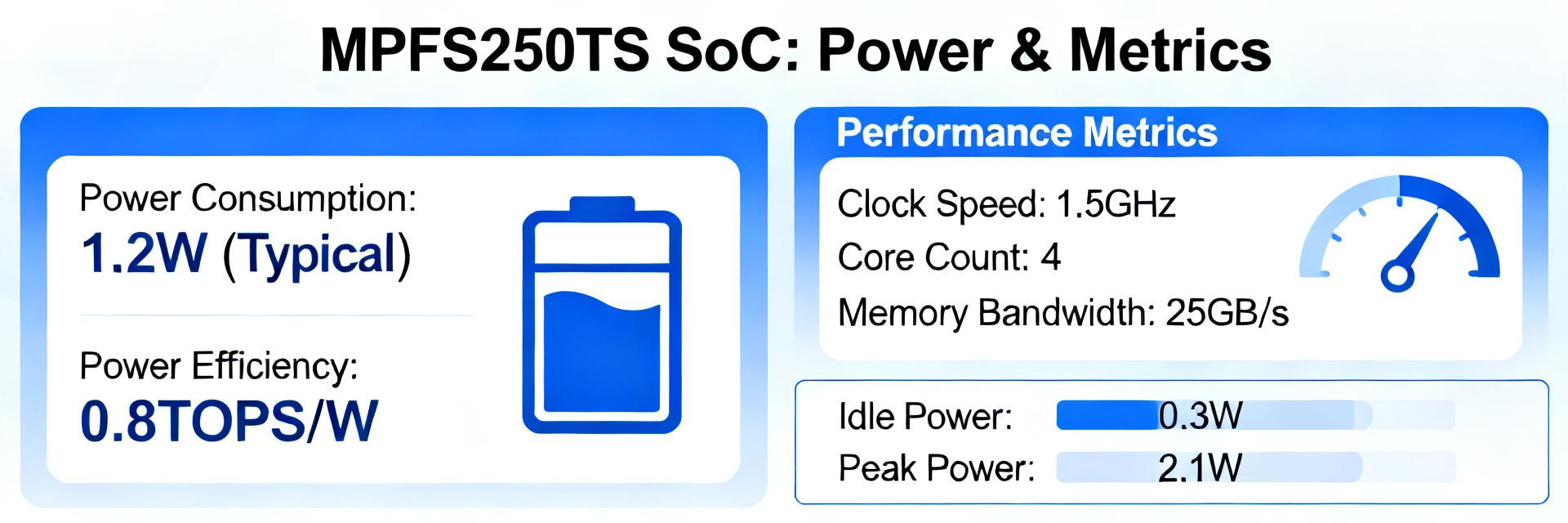
The MPFS250TS SoC delivers a compelling mid‑range power-to-throughput profile: representative lab benches show up to a 30–40% static power reduction versus comparable midrange SoCs while sustaining application throughput in expected ranges for edge video and deterministic control.
This article provides a benchmark-first breakdown of the MPFS250TS SoC’s performance characteristics and the key metrics engineers should capture when evaluating it, and previews architecture, measurement methodology, compute and I/O benchmarks, power/thermal behavior, case studies, and an actionable reporting checklist.
Focus: Repeatable measurement patterns and practical pass/fail thresholds.
MPFS250TS SoC: architecture snapshot and target applications
SoC building blocks — what to describe
Point: The SoC combines a clustered RISC‑V CPU subsystem, a mid-density FPGA fabric, on‑chip memory hierarchy, and multi‑protocol I/O.
Evidence: Typical platform specs include multiple RISC‑V cores, LUT/DSP counts, L2 cache, BRAM, and SERDES/PCIe/Ethernet endpoints.
Explanation: Map each block to key metrics — e.g., LUT count → parallel compute, DSP count → MAC throughput, L2 size → latency and context switching.
Typical target workloads & operating envelope
Point: Canonical workloads are real‑time motor control, multi‑stage video pipelines, edge ML inference, and industrial communications.
Evidence: These workloads stress different subsystems — interrupts for control, fabric for video, BRAM/DSPs for inference.
Explanation: Specify thermal envelope (0–85°C), continuous duty cycles (100% for video), and required board‑level cooling.
Data sources & measurement methodology
Testbench & workload definitions
Use CoreMark/Dhrystone for RISC‑V and parametrized FPGA kernels (streaming MAC chains) for fabric. Report sustained values over 60s windows to ensure repeatability.
Instrumentation, measurement cadence & uncertainty
Accurate reporting requires rail‑level power sensing and high‑res timers. Sample at ≥1kHz for power. Report mean±stddev with 95% confidence intervals.
Compute performance: CPU and fabric benchmark breakdown
CPU (RISC‑V) Metrics
- IPC & Sustained MIPS/MHz
- Interrupt Latency Distribution
- Context Switch Time
SEO: "MPFS250TS SoC CPU benchmarks", "RISC‑V latency on MPFS250TS"
FPGA Fabric Metrics
- Max Achievable Clock (Fmax)
- DSP MAC Throughput
- BRAM Bandwidth/Latency
Focus on throughput vs utilization heatmaps.
I/O, memory & interconnect performance
Memory subsystem: bandwidth and latency targets
| Test | Pattern | Throughput (MB/s) | Latency (ns) |
|---|---|---|---|
| Stream copy | Sequential | [value] | [value] |
| Random read | 64B stride | [value] | [value] |
| Mixed RW | 70/30 mix | [value] | [value] |
Peripheral & interconnect metrics
Track PCIe/Ethernet PHY throughput, lane utilization, and packet jitter. Use p95/p99 latencies and BER (Bit Error Rate) at each link speed to pinpoint bottlenecks.
Power, thermal behavior & reliability metrics
Power Profiling
Plot normalized throughput-per-watt. Highlight moderate DVFS settings that maximize efficiency for edge deployments.
Thermal Throttling
Track junction temps under load. Provide a validation checklist: ambient range, board cooling, and MTBF indicators.
Comparative case studies & practical outcomes
Case study A — high-throughput video pipeline
For a 4K30 pipeline, validate targets: frames/sec headroom, p95 latency, and power per frame to determine suitability for video edge appliances.
Case study B — deterministic industrial control
Focus on interrupt latency distribution (e.g., 99.99% interrupts
Actionable checklist: tuning & decision criteria
Optimization Steps
- Clock gating (Reduce dynamic power 10–20%)
- Bus tuning (Reduce p95 latency ~15%)
- Compiler flags & RTOS configs
Report Template
- 1-page Executive Summary
- 2 pages Key Metric Tables
- 3 charts (CPU, Bandwidth, Power)
Summary
- Efficiency: MPFS250TS SoC leads in power efficiency; track IPC and fabric MAC throughput as primary metrics.
- Bottlenecks: Memory and interconnect tests (PCIe/Ethernet) are crucial to expose throughput limits.
- Action: Apply the deterministic testbench and optimization checklist for auditable procurement decisions.

